 Antigua Guatemala City Guide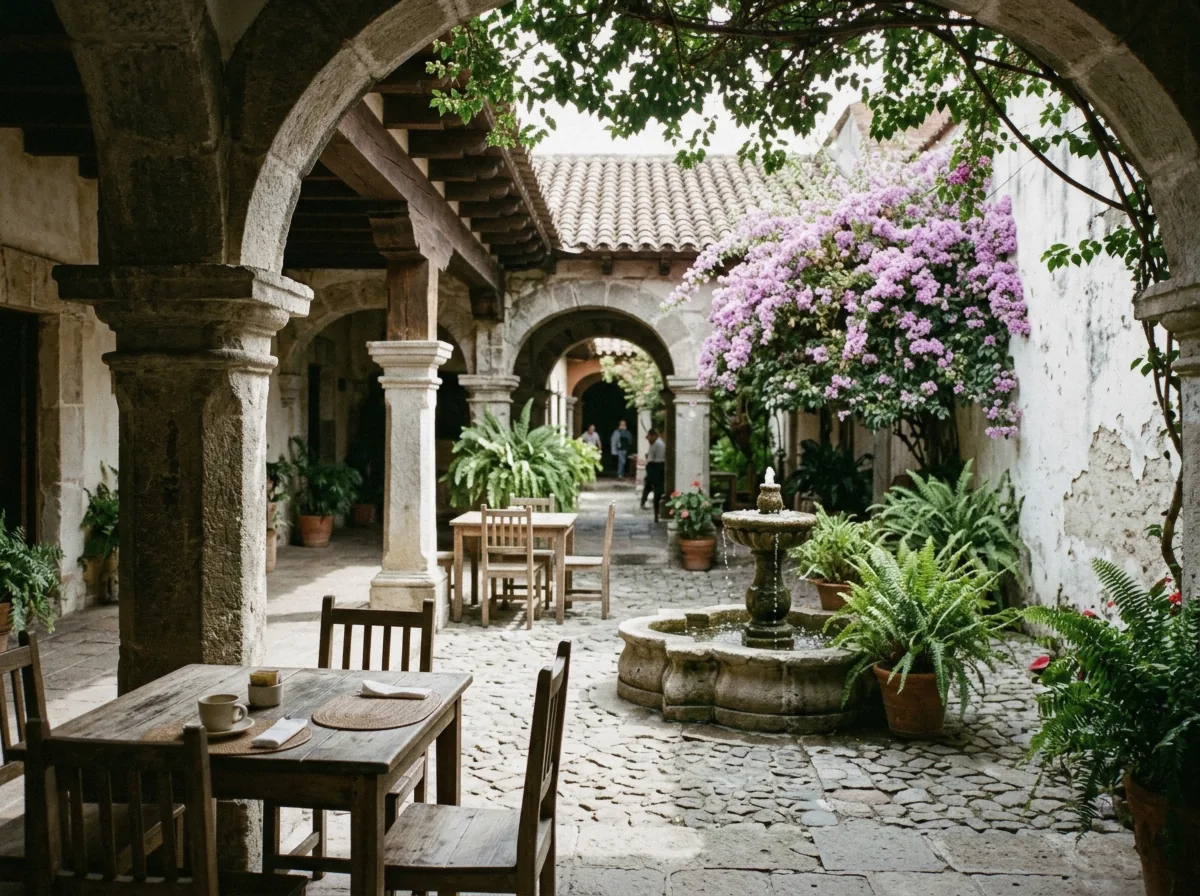
Where to Stay in Antigua Guatemala
Where to stay in Antigua Guatemala comes down to 6 areas, and the difference between a first-visit base and a quiet one is about 4 blocks. This guide compares them by walk minutes to Parque Central, what each costs in transport, and who each suits, with the area guides on the Antigua Guatemala city guide. No nightly rate bands are printed, because almost none are published. The one hotel that prints its rates is named. Hotel cards with live search follow the area guides.
Quick answer First visit, quiet nights, long stays: one area for each
If it is your first time in Antigua and you are deciding where to stay, sleep inside the colonial grid around Parque Central. Every sight on a first list is a walk, and the evenings happen where you sleep. If you want calm nights, or you are coming for Semana Santa with a car, look at the 5a/6a Avenida Sur blocks and Alameda Santa Lucía on the quiet west edge. Culture-and-coffee travellers and families with a car do better in Jocotenango, and long stayers find the cheapest beds toward San Felipe.
Key takeaways
- First visit: the colonial grid around Parque Central, everything on a first list is a walk. The room-level comparison lives on the hotels page.
- Quiet nights: 5a/6a Sur and Alameda Santa Lucía, monastic blocks eight to fifteen minutes from the park.
- Long stays and budget: San Felipe or a hostel dorm.
- Once the area is picked, see stays by area: every card opens a live search for that area.
The six stay areas compared
Six areas of Antigua compared on what matters for a bed: how far the walk to Parque Central runs, who each area suits, and what to watch out for. The walk minutes are street-geometry estimates, not official figures, and each one links to its full section below.
| Area | Walk to Parque Central | Best for | Watch out for | Guide |
|---|---|---|---|---|
| Centro (the colonial grid) | 0-5 minutes, the whole grid is walkable | First visit, short stays, evenings out | Street noise until late, the busiest sidewalks, the highest asking rates | Centro section below |
| 5a/6a Avenida Sur and Alameda Santa Lucía | about 8-15 minutes (estimate) | Calm nights, couples, Semana Santa with a car | Procession closures cut it off on Holy Week Sundays | South-west edge section |
| San Felipe | 30-40 minutes on foot, short tuk-tuk (estimate) | Long stays, budget travellers, locals' pace | The walk home after dinner is long. Buses and tuk-tuks end early | San Felipe section |
| Jocotenango | 25-35 minutes on foot, minutes by tuk-tuk (estimate) | Coffee and culture, families with a car | You will not walk home for lunch. Evenings happen in town | Jocotenango section |
| El Hato (the ridge above San Felipe) | 15 minutes by vehicle, then 300 m on foot | Views, hammocks, a slow few days | No car-free nightlife, the last ride down decides your evening | El Hato section |
| Santa Ana | about 10-20 minutes on foot (estimate) | Slow-travel couples, convent-quiet streets | Few services of its own. Dinner is back in the grid | Santa Ana section |
No area in this table is more than 40 minutes from the park on foot, and a tuk-tuk closes the gap for the municipal fare of about Q10 ($1.31).
The six areas on the map
Amber pins mark five of the six areas; El Hato has no pin because the lodge that anchors it publishes no coordinates and the ridge has no street address to pin. Green pins are the two fixed points: the park every walk is measured from, and the bus terminal behind the market. Area pins sit on the district, not on any door.
Centro: the colonial grid, for a first visit
The grid that gives the city its name
This is the part of Antigua that carries the UNESCO World Heritage listing, granted in 1979. It is the checkerboard of paved blocks between the Santa Catalina arch and Parque Central, low volcanic-stone walls, ruined convents and doorways that open into courtyards. Stay here and you stop thinking about transport.
The park, the arch, the markets and the museums are all within five minutes on foot, and the Cerro de la Cruz viewpoint is a 20-30 minute climb when you want the volcano postcard. Two or three nights here and the city explains itself. The trade-offs are the price of the address.
These are the loudest sidewalks in the valley, with bar music carrying late and foot traffic on the arch street well into the evening. They are also the highest asking rates in town, and almost nothing is published for you to compare against. The one citable anchor sits here: Hotel Museo Spa Casa Santo Domingo, the converted monastery on 3a Calle Oriente, lists rooms from $225 (Q1,719), the only hotel in the city that prints its rates openly.
Everyone else quotes on search. When you want dinner, the verified restaurants within a five-minute walk include the fine-dining rooms inside Casa Santo Domingo itself, the rooftop at Café Sky and the crêperie Luna de Miel on 6a Avenida Norte.
5a/6a Avenida Sur and Alameda Santa Lucía: quiet nights
Monastic blocks on the west edge
Walk eight to fifteen minutes south-west from the park and the streets change character. These blocks around 5a and 6a Avenida Sur and Alameda Santa Lucía hold old monastery and convent conversions set a street back from the noise, walls high enough that the evenings stay quiet. This is Mesón Panza Verde territory, the restaurant-hotel on 5a Avenida Sur that books its tables online and draws the city's slow-dinner crowd.
You trade five minutes of walking for sleep, and for most couples that is a good trade. There is one seasonal complication, and it cuts both ways. In Semana Santa the municipality closes the procession streets to traffic, and Palm-Sunday closures include Calzada Santa Lucía, the road that feeds this corner of town.
The Santa Inés end of Alameda Santa Lucía is also where the municipality parks the cars for the season and runs its free shuttle buses from the lots. If you are visiting in February and March with a rental car, staying near that end means the car has somewhere official to live. During Holy Week itself it means the neighbourhood absorbs the whole season's traffic machine.
The rest of the year it is simply the calmest walkable address in the city. For anyone choosing a second Antigua trip rather than a first, this is usually the answer.
San Felipe: long stays and the locals' city
South-west, residential, cheaper
San Felipe sits south-west of the grid on the old road toward Ciudad Vieja, past the edge where the tourist city stops and the residential one starts. It is a real neighbourhood, with a church square, street food and a pace set by people who live here rather than by visitors. The walk to Parque Central runs 30-40 minutes, or a few minutes by tuk-tuk.
The municipal tariff is Q10 ($1.31) per ride inside the city, though practice often runs higher for visitors, so agree the fare before you get in. Here is the honest gap: no citable hotel anchor exists for San Felipe. Nothing publishes a rate we can quote, and we will not invent one.
That absence is itself information. The guesthouse economy here prices itself for residents, Spanish students and long stayers, not for the two-night market, so the value is in the monthly and weekly arrangements that never reach the booking platforms. The citable beds that do exist belong to the language schools, whose classrooms sit in the grid and whose homestay programs put a bed with a local family at the family's own address.
Spanish Academy Antigüeña sells a family homestay from $130 (Q993.20) a week, shared bath, three meals a day except Sundays, which is the cheapest citable bed in the valley. If you are studying, staying long, or stretching a budget past a fortnight, a homestay plus a residential base beats anything the colonial grid can quote.
Jocotenango: coffee, culture and families
The finca town on the north-west edge
Jocotenango is the adjacent town just past the north-west city line, and its anchor is Finca La Azotea, a working cultural estate. On the finca grounds sit the Museo del Café, open daily 9am-6pm, the Casa K'ojom music museum, and a cluster of courtyard restaurants: El Maízal serves Guatemalan cooking Tuesday to Sunday 9am to 4:30pm, La Azotea Carbón grills daily 8am to 6pm, and the Azotea Deli and Jardín fill the gaps. There is a chocolate workshop for rainy afternoons.
For a family, a week here looks very different from a week in the grid: coffee in the morning, courtyard lunch, the city in the afternoon. The walk to Parque Central runs 25-35 minutes, or minutes by tuk-tuk at the municipal fare of about Q10 ($1.31). The honest cost is the evening pull.
You will not walk home for lunch, and after dinner in town you are riding back rather than strolling. Families with a car feel none of this. Coffee-and-culture travellers who came for the finca rather than the ruins often prefer it.
No hotel in Jocotenango publishes rates we can cite, so the fit is described, not priced. If the finca lifestyle is the reason you came, this is the area, and the trade in convenience is one you can see coming.
El Hato: the ridge, for views and hammocks
Up the mountain above San Felipe
El Hato is a village about 15 minutes by vehicle above San Felipe, on the green shoulder of the volcano. Its anchor is Earth Lodge, an avocado farm with 350 or more organic avocado trees and a lodge built for views, hammocks and slow days. The restaurant is open to the public daily 8am-8pm, with the cafe and bar running 7:30am to 9:30pm, and day visitors make the trip up for lunch as often as guests stay the night.
The lodge sits 300 metres from the nearest road, so every arrival ends in a short walk on a dirt path. The trade is services. There is nothing car-free after dinner up here.
The last ride down decides your evening, and if you have not planned it, your evening is on the ridge. How thin mountain services are showed clearly when the lodge's own site announced a full kitchen-renovation closure for all of September, with reopening announced for October 1. One kitchen, one closure, and the whole hill's dining stops.
This area suits the traveller who came for the valley view and a stack of books. It does not suit anyone who wants to step out after dark into a bar street.
Santa Ana: the quiet east edge
Convent streets ten minutes east
Santa Ana runs along the east edge of the grid, toward San Pedro Las Huertas, around a church and convent complex that gives the neighbourhood its hush. The walk to Parque Central is about 10-20 minutes, close enough to reach everything and far enough that the tour-group current never reaches you. These are the quietest residential streets of the six areas, cobbled, low-walled, and mostly free of anything that plays music.
The honest line first: no citable rate anchor exists here either. Nothing in Santa Ana publishes a price, so we describe the area and let the live search do the quoting. That is the same rule we applied to San Felipe and Jocotenango, and it is the reason this page prints no rate bands.
What you buy in Santa Ana is silence with the grid still in reach. Slow-travel couples who want to write, rest or decompress after long Guatemala legs fit it best. The trade is services.
The neighbourhood has few of its own, so dinner is a walk back into the centre, and if you have spent the whole day on your feet the 20-minute return after a late meal feels longer than the 10-minute outbound. Pair this area with a plan: eat early, walk home by lantern light, sleep with the windows open to birdsong instead of bar sound.
Check stays in each area
Antigua publishes no nightly rates a guide can cite, because aggregator floor figures move daily. So these cards carry the walk, the fit and a live search instead of a band. The one published anchor, Casa Santo Domingo at rooms from $225 (Q1,719), sits in the Centro card.
Centro (the colonial grid)
- Walk to Parque Central
- 0-5 minutes
- Suits
- A first visit, two or three nights, evenings where the sights are
The published anchor lives here: Hotel Museo Spa Casa Santo Domingo lists rooms from $225 (Q1,719), the only hotel in the city that publishes its rates. Everything else is quote-on-search. Ask which way the room faces: the arch street carries foot traffic until late.
See stays in Centro (the colonial grid)5a/6a Avenida Sur and Alameda Santa Lucía
- Walk to Parque Central
- 8-15 minutes (estimate)
- Suits
- Calm nights, couples, Holy Week with a car
Monastic blocks a street back from the noise. In Semana Santa the procession closures start at the Santa Inés end, which is also where the municipality parks the cars.
See stays in 5a/6a Avenida Sur and Alameda Santa LucíaSan Felipe
- Walk to Parque Central
- 30-40 minutes or a short tuk-tuk (estimate)
- Suits
- Long stays, budget travellers, a locals' pace
No published rates to quote, which is the point of the area: the guesthouse economy here prices itself for residents, not visitors. Agree tuk-tuk fares before you get in.
See stays in San FelipeJocotenango
- Walk to Parque Central
- 25-35 minutes or minutes by tuk-tuk (estimate)
- Suits
- Coffee and culture travellers, families with a car
The finca with the coffee museum and the courtyard restaurants is the anchor. You are buying calm at the price of walking back into town every evening.
See stays in JocotenangoEl Hato (the ridge)
- Walk to Parque Central
- 15 minutes by vehicle, then 300 m on foot
- Suits
- Views, hammocks, a slow few days off the grid
The lodge's own restaurant is the only service up here (8am-8pm, day visitors welcome). The last ride down decides your evening.
See stays in El Hato (the ridge)Santa Ana
- Walk to Parque Central
- 10-20 minutes (estimate)
- Suits
- Slow-travel couples who want silence in reach of the grid
The quietest streets of the six and the thinnest services. Dinner is a walk back into the centre.
See stays in Santa AnaNo nightly rate bands are printed on this page because none are published: the Booking.com city page counts 338 properties and quotes live prices only, and one hotel, Casa Santo Domingo, prints its rates openly. Figures quoted here come from the hotels' own sites at our last review. We take a commission if you book through these links, at no extra cost to you, see the affiliate disclosure. No Antigua hotel tax figure is printed anywhere on this site because no official source publishes one. The checkout total is the number to trust.
What a room costs: the published rates to compare
The one-anchor problem
Almost nothing in Antigua publishes a room rate. Hotels quote through booking engines, the numbers move daily, and a guide that prints a band is printing a guess. One property breaks the pattern.
Hotel Museo Spa Casa Santo Domingo lists its rooms openly, and the hill lodging of the same estate, Santo Domingo del Cerro, publishes its airstreams and containers and its three-bedroom house. Those figures, plus the schools' published homestay prices and the booking platform's own city floor, are every citable number this page has.
| Anchor | What it is | Figure |
|---|---|---|
| Casa Santo Domingo, Centro | the one hotel publishing room rates | from $225 (Q1,719) |
| Santo Domingo del Cerro hill lodging | airstreams and containers up the hill | from $190 (Q1,451.60) |
| Santo Domingo del Cerro, three-bedroom house | the top of the published range | from $495 (Q3,781.80) |
| School homestay with meals, any of the three schools | a week of bed and three meals a day | $130-235 (Q993.20-1,795.40) a week |
| Booking.com city page floor | the platform's own entry figure for the city | from $76.95 (Q587.90) |
Derived numbers and cash
The homestay weeks work out between $18.57 and $33.60 a night, with food included, which is why Spanish-school students keep finding beds the two-night market never sees. The school on-site rooms are a different product: San José El Viejo charges $470-610 (Q3,590.80-4,660.40) a week with breakfast on weekdays, which works out at $67.10-87.10 a night, competitive with the grid without being in it. Cash matters more the further out you sleep.
ATM fees in Antigua commonly run Q40-49, about $5.24-6.41 per withdrawal, and the fees seem fixed regardless of the amount, so withdraw larger sums less often. Tuk-tuks and the market are cash economies. One line on taxes.
No official source publishes an Antigua hotel tax, so none is printed here. The checkout total is the number to trust. For everything else the city costs, see the full cost picture.
Figures current in Q3 2026.
Room and lodging rates from casasantodomingo.com.gt; homestay and on-site room prices from spanishacademyantiguena.com, sanjoseelviejo.com and ixchelschool.com; the city floor figure from booking.com's own city page summary. All quoted as published, converted at this site's fixed rate of $1 = Q7.64.
Getting from the airport to your bed
The transfer, in order of certainty
You land at La Aurora in Guatemala City, 40-45 km away, and the road takes 45 minutes to an hour and a half off-peak. Pre-book a shared shuttle and the trip costs $15 (Q115) a head on the operator's own published fare. Decide at the arrivals curb and the walk-up vans run about Q150 ($19.63) a seat through the day until around 20:00.
A private transfer removes the clock entirely, and no official airport taxi tariff exists, so any figure a dispatcher gives you is a negotiation, not a table. The options, with every figure from the operators' own pages or the sources named on the airport page:
| Option | Price | When it runs |
|---|---|---|
| Shared shuttle, booked ahead (Adrenalina) | $15 (Q115) per person | daily 06:00, 09:30, 11:00, 13:30, about 2 hours |
| Shared shuttle, walk-up at the airport | about Q150 ($19.63) per person | all day until about 20:00, needs 3 or more riders |
| Private transfer (Turansa), 1-4 passengers | $50 (Q382) per trip, $15 more after 21:00 | any hour |
| Charter pickup with name sign | about Q250-350 ($32.70-45.80) | arranged ahead |
| Chicken bus, the budget extreme | Q15 ($1.96), cash only | frequent by day from the El Trebol intersection in Guatemala City |
The last hundred metres
Antigua's streets are cobbled and several are narrow or pedestrian, so ask the driver to stop at the nearest corner your guesthouse allows and walk the last half block with your bag. The chicken bus drops near the market, which is honest value if you travel light by daylight, but it is crowded, and the UK Foreign Office advises against public buses in Guatemala altogether, so treat it as a daytime adventure rather than an arrival plan. The chicken bus guide has the detail, and getting around town covers the rest of the week.
Booking for Semana Santa
What is documented, and what is not
The honest line first: no official source states when Antigua hotels sell out for Holy Week, so this page makes no book-by-X-months claim and you should distrust any guide that does. What is documented is the machinery around the season, and the machinery tells you how to choose a street. The municipality closes the procession streets to vehicles on the big days, active from 4:00 a.m. on procession Sundays.
The Palm-Sunday closure list has included Calzada Santa Lucía among its streets. Parking for the season is pushed out to the Santa Inés and La Pólvora lots, with the MarbEx vehicle sticker at Q10 ($1.30) on weekdays rising to Q20 ($2.60) on Fridays, weekends and the season itself, and free shuttle buses running from the lots into town. Shops and deliveries resupply only before 04:00 from Holy Thursday through the holiday.
Read that as a traveller and one rule falls out: sleep on a procession street only if you came for the processions. The carpet-laying, the incense and the crowds are the reason the season is famous, and they are also a wall of sound and blocked doors from dawn. Everyone else should pick a street one block off the routes and treat the processions as an excursion.
The full Semana Santa guide covers the routes in detail.
Which area to think twice about
Consensus, and the functional answer
Start with the advisories, because the internet rarely does. No area of Antigua carries an official travel restriction. The US advisory for Guatemala overall sits at Level 3, Reconsider Travel, and the UK FCDO's only no-go strips are on the Mexican border, nowhere near Sacatepéquez.
So no district of this city is formally off limits, and any page claiming otherwise is selling something. The real think-twice list is functional. The terminal streets behind the market are the city's busiest working corner and deserve caution after dark, as any bus district does.
El Hato deserves caution at any hour if you have not planned your ride home, because the last tuk-tuk down the hill is the difference between dinner in town and dinner on the ridge. And anywhere at all deserves caution if your flight lands at 22:00, because tuk-tuks stop working around 22:00 and hoping for one is not a plan. Book the transfer instead.
If something does go wrong, the tourist police are DISETUR, and the ASISTUR hotline is 1500, staffed 24/7, with WhatsApp on +502 5188-1819. The safety and scams page covers the street-level detail.
The first evening in your new area
A 5.0-rated highlights walk fixes your bearings on night one, which is the cheapest way to learn which streets you want to wake up on. The shared van to Panajachel is the budget line out when the area changes.
 from $25
Antigua Guatemala: City Highlights Guided Walking Tour
2.5-hour small-group walk through the grid with a licensed guide; the fastest way to make the ruins and churches mean something.
Check Availability from $25
Antigua Guatemala: One-Way Shared Van Transfer to Panajachel
Direct shared van Antigua to Panajachel, the gateway town for Lake Atitlan; three hours, no changes.
Check AvailabilityPrices, ratings and details are the platforms' own.
Prices, ratings and details are the platform's own. dollar figures are the listed prices — the platform bills in your account's currency.
Where to sleep, then where to eat
Hotels by category and budget
The room-level comparison by area and category, with every citable rate anchor and the honest gaps: Antigua Guatemala hotels.
The money pageHostels and the social scene
Dorms, party streets and the cheap beds the schools sell: Antigua Guatemala hostels.
Backpacker tierEating near your area
Every restaurant this site could verify on its own site, grouped by area: where to eat.
16 tablesWhere to stay in Antigua: questions
What area of Antigua should I stay in?
For a first visit, the colonial grid around Parque Central, because every sight and every good dinner is a walk away. The reasoning and the walk times for all six areas are laid out in the comparison table.
What is the best side of Antigua to stay on?
The west and south-west edges, around 5a and 6a Avenida Sur, are the calm side, and the grid is the sights side. But the side matters less than the street, because one street back from the arch or the park changes the noise completely.
Is it better to stay in Antigua or Guatemala City?
Antigua, for the stay itself. The capital is an airport stop, 45 minutes to an hour and a half away by road. The transfer options are compared in getting from the airport.
What is the best place to stay in Antigua?
The honest answer is that only one hotel publishes its rates, Casa Santo Domingo, from $225 (Q1,719), so best is a question of fit rather than price. See what a room costs for every citable figure.
Where should I stay in Antigua on a budget?
San Felipe, where the guesthouse economy prices for residents, and the school homestays from $130 (Q993.20) a week with meals. The dorm picture is on the hostels page.
Do hotels in Antigua charge a tourist tax?
No official source publishes one, so none is quoted anywhere on this site. Trust the checkout total, and read what a room costs for how we handle rates.
Which area works for a very late arrival?
The grid, because transfers reach it at any hour, and a private transfer is $50 (Q382), adding $15 after 21:00. Tuk-tuks stop around 22:00, so do not book a ridge lodge for a midnight landing. The details are in arriving.
Prices, hours and terms are set by the venue or operator and confirmed at checkout.
We may earn a commission if you book through one of our links, at no extra cost to you. Full affiliate disclosure