 Antigua Guatemala City Guide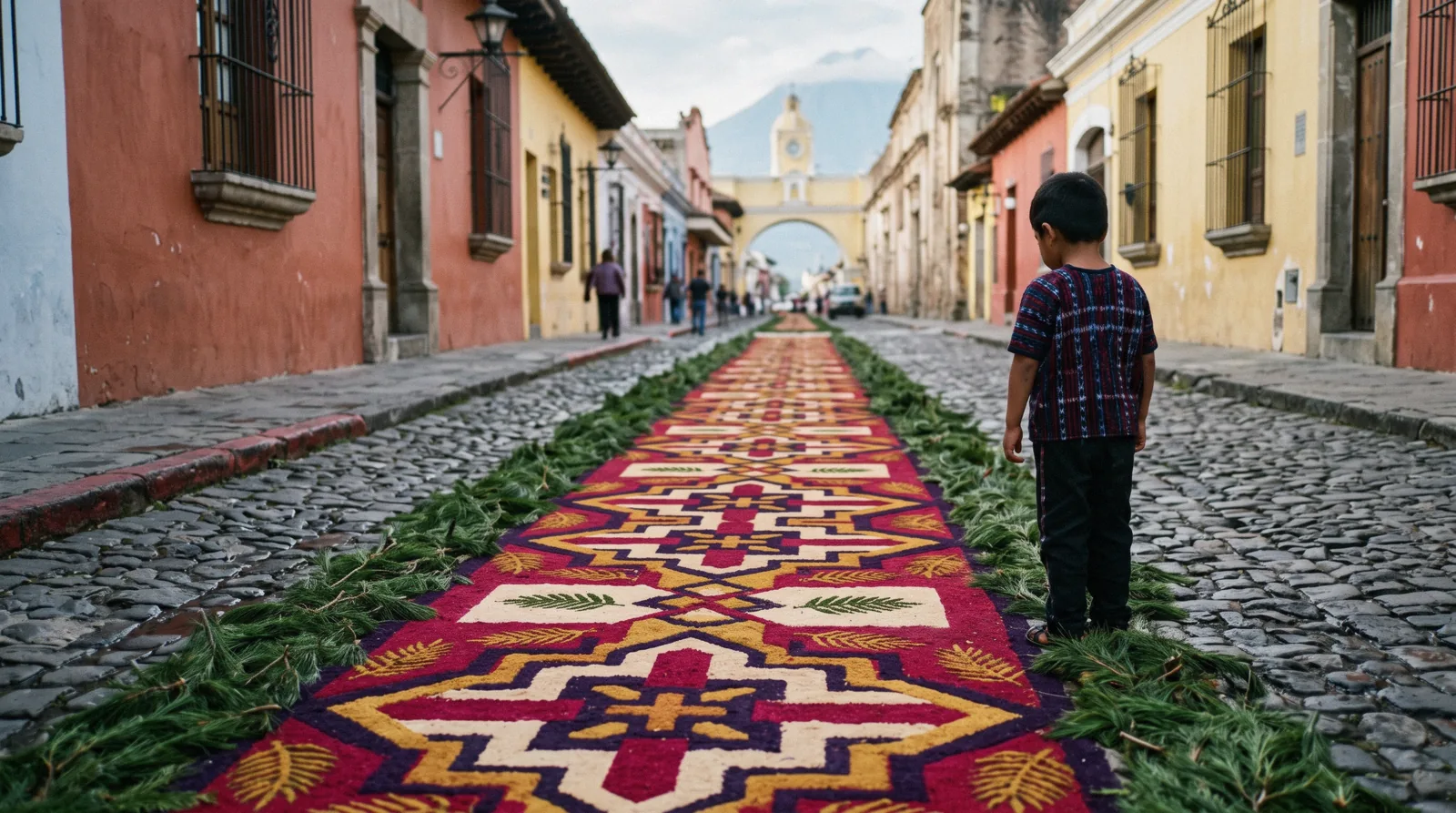
Semana Santa in Antigua Guatemala: 2027 Dates, Processions and Alfombras
Semana Santa in Antigua Guatemala is the defining event of the city's year, played out across the UNESCO-listed colonial grid. For Semana Santa, Antigua Guatemala carpets its streets in dyed-sawdust alfombras and hands them to processions that walk over them from Lent through Easter. The 2027 anchor dates are Palm Sunday 21 March, Good Friday 26 March and Easter Sunday 28 March. One honest note up front: the 2027 programación is not yet published, so no procession times or routes exist to print yet. Start with the Antigua Guatemala city guide and the planning hub to frame the trip, then use this page for the season itself.
Quick answer The 2027 dates, the scale, the carpets and the one honest scheduling caveat
Semana Santa in Antigua Guatemala is the city's defining event: about 56 velaciones and 58 processions in the municipal plan, streets carpeted in dyed sawdust alfombras, and a pedestrian perimeter from 4:00 a.m. on the big days. In 2027 Palm Sunday falls on 21 March, Holy Thursday 25 March, Good Friday 26 March and Easter Sunday 28 March. These dates are computed from the Easter date, so cross-check a calendar at launch. The 2027 procession programación is not yet published. The municipality's own assistant at muniantigua.gob.gt publishes locations, the perimeter map and parking in season. Lock the arrival and the room early, then let the city do the rest.
Key takeaways
- The season runs from Palm Sunday on 21 March to Easter Sunday on 28 March 2027. See the key days of the season for what each day brings.
- Alfombras are built by families on the street and walked over hours later. Read the alfombras guide before you go.
- The arrival decides the trip. Work out flying in and lock a shared transfer early.
- Sleeping in town beats commuting during the perimeter. Compare where to stay before booking.
The Key Days of the Season, With 2027 Dates
This table compares the days that structure the season, from Ash Wednesday to Easter. The 2027 dates come from the Gregorian calendar computed from the Easter date, so cross-check a calendar at launch. The operating facts come from the municipality's 2026 plan, because the 2027 programación is not yet published. That is why no procession times or routes appear anywhere on this page. In season, the municipal assistant carries the live detail.
| Day | 2027 date | What happens | Municipal logistics |
|---|---|---|---|
| Ash Wednesday | 10 February | Lent begins. The velaciones and Lent-size processions start building toward Holy Week | Streets open. First visitors arrive for the smaller Lent processions |
| Lent Sundays (six) | 14 February – 14 March | One procession per Sunday through the city, plus velaciones. The season runs Palm Sunday to Easter Sunday overall | Open streets. The practice run for Holy Week logistics |
| Palm Sunday | 21 March | Palm blessings open the week. A full procession day. The 2026 plan closed Calzada Santa Lucía, 9a calle, Chipilapa, Calle de los Duelos, Ánimas, Calle Ancha y Desengaño | Pedestrian perimeter active from 4:00 a.m. |
| Holy Thursday | 25 March | Visits to the seven churches, velaciones open, evening processions. Bars close by municipal order in recent years | Perimeter active. Resupply ends, from here deliveries run only until 4:00 a.m. |
| Good Friday | 26 March | The biggest day of the year: the major processions and the densest carpet work of the season | Perimeter active from 4:00 a.m.; the city is on foot |
| Holy Saturday | 27 March | Quieter streets in the morning. Velaciones remain open. The city resets for Easter | Perimeter easing. Parking lots still running |
| Easter Sunday | 28 March | The Resurrection processions close the season | Perimeter active. Traffic returns on Monday |
The named processions of the city include Jesús Nazareno del Milagro, Jesús Nazareno del Perdón and el Señor Sepultado de la Escuela de Cristo. Exact routes and start times belong to each hermandad and to the municipality's programación, which is not yet published for 2027, the municipal assistant carries them in season.
What Semana Santa Is: Velaciones, Processions, Scale
The season has a long arc. It opens with Ash Wednesday, on 10 February in 2027, and the six Lent Sundays run from 14 February to 14 March. Each Lent Sunday brings a procession of its own plus velaciones, and the whole thing builds week by week toward Holy Week.
The climax is Palm Sunday to Easter Sunday, 21 to 28 March in 2027, and the season ends with the Resurrection processions on Easter Sunday. Nothing runs after that. Two words carry the tradition.
A velación is a vigil display, built around the procession image, that stays open for visitors to see. A procession is the event itself: the anda, a huge wooden platform bearing the image, carried on the shoulders of cucuruchos in purple robes over the alfombras. The carpets lie on the cobblestones ahead of it and the walk destroys them.
That destruction is the point. The scale is hard to picture until you stand in it. The municipal 2026 plan counted about 56 velaciones and 58 processions across the city, under the theme "Recorriendo paso a paso una tradición de fe".
The press guide to the season names Jesús Nazareno del Milagro, Jesús Nazareno del Perdón and el Señor Sepultado de la Escuela de Cristo among the city's processions. Now the honest scheduling paragraph. The 2027 programación is not yet published.
No procession start times and no procession routes exist in any source this guide can cite, so none appear on this page. Expect the program from the municipality and the hermandades as the season approaches, and in season use the municipal assistant at muniantigua.gob.gt, which carries real-time procession locations, the perimeter map and parking. Treat any timetable you see elsewhere with suspicion until the municipality publishes one.
The structure above is the citable 2026 operating pattern, and the municipality has run the season the same way for years.
Alfombras: The Carpets and Who Makes Them
The raw material is sawdust, aserrín, dyed in strong colors and worked through stencils into designs: geometric patterns, religious scenes, letters, flowers. The finest carpets use the sawdust like pigment, sifted layer by layer. Simpler ones use pine needles, flowers and fruit.
All of it lands directly on the cobblestones, with nothing underneath. Who builds them? Families, neighbours, coworkers and brotherhoods.
Building an alfombra is a street-level activity during Holy Week week. You will see children stenciling the outline while adults fill it in, and a whole block adopting one stretch of road. This is not a show put on for visitors.
It is the neighbourhood preparing for a procession that will pass its own door. The rhythm is quick and unforgiving. A carpet is finished only hours before its procession walks over it.
The anda and its bearers cross the whole thing in minutes, and what remains is swept away immediately so the next procession's carpets can be laid. The same street can host several carpets in a single day. The municipal resupply rule belongs to this rhythm: shops and deliveries run normally Monday to Wednesday of Holy Week, then only during the small hours until 4:00 a.m. from Holy Thursday to Easter.
Where do the best carpets concentrate? On the processions' own routes, which for 2027 are not yet published. In 2026 the Palm Sunday closures named Calzada Santa Lucía, 9a calle, Chipilapa, Calle de los Duelos, Ánimas, Calle Ancha y Desengaño, and those procession corridors are where carpet work clusters.
Etiquette is simple. Never step on or lean over a finished alfombra. Photograph from the curb.
Do not block a working street. If you want to see the craft at its best, come in the morning when carpets are being built, not just when they are walked over. For the indoor complement, the Museo de la Semana Santa sits in the claustro de Sor Juana de Maldonado, on INGUAT's museums list.
It explains the processions, the dress and the carpet tradition when the streets are too packed to study them.
The Booking Window: What Can and Cannot Be Said
Start with what cannot be said. Whether and when Antigua's hotels sell out for Semana Santa is not stated by any official source. INGUAT publishes nothing, and the searches turn up no citable figure.
So any line like "book by November" would be invented, and this guide will not invent it. What follows is only what is on the record. On the record: Casa Santo Domingo publishes rates from $190 (Q1,451.60) a night on its own site, the only hotel rate formally published in relation to this page.
Also on the record: Turansa's private-shuttle rates are explicitly not valid during Holy Week. Operators reprice or pause for the season, which tells you demand is real without inventing a sell-out date. The practical reading follows from those two facts plus the calendar.
The key nights are 24 to 28 March 2027, Holy Thursday through Easter Sunday. Inventory around those dates is the tightest of the year, whatever the official position on sell-outs. So book rooms and arrivals early, in that order, and hold the rest of the plan loose.
Get the arrival right first by reading flying in, then choose a private transfer or a shared shuttle before prices move. For rooms, compare the areas in where to stay and favor anything inside the grid or near a free-bus lot, because the perimeter turns the center pedestrian from 4:00 a.m. on the big days. What book early means in practice depends on the trip.
If you are coming for Good Friday only, the honest pattern is to sleep within walking distance of the grid, because driving in on the morning itself is not a plan the perimeter allows. If you are staying the whole week, the earlier nights are the cheaper and calmer ones, and the same room often works harder: you can watch the carpets being rebuilt street by street instead of commuting. Either way, hold a fallback in Guatemala City, 40–45 km away, and treat it as the overflow valve rather than the plan.
One last calibration. The 2027 dates on this page are computed from the Easter date and flagged for a calendar cross-check at launch. They are solid enough to book around, but confirm them against a published calendar before you commit non-refundable money.
What Holy Week Costs, Compared: MarbEx, Parking, Free Buses
What actually costs money
Holy Week itself costs almost nothing to watch from the curb. The real costs are municipal and small, built to keep cars out of the perimeter and visitors moving on foot and by free bus. The three pieces are the MarbEx vehicle sticker, the park-and-ride lots with their daily cap, and the resupply clock that changes how you shop.
The vehicle sticker
Every vehicle entering the protected colonial grid during Semana Santa carries a MarbEx sticker, bought online at portal.muniantigua.gob.gt before you drive. The fee is tiered by vehicle type and by day, with the higher rate applying on Friday, weekends and Semana Santa itself. The daily cap at the Santa Inés and La Pólvora lots is Q40 ($5.24) for cars.
The logic is simple: fewer cars inside the perimeter, more room for processions, carpets and pedestrians. The 2027 fee schedule is pending, so treat this 2026 structure as the working plan.
| Vehicle | Mon–Thu | Fri, weekends and Semana Santa |
|---|---|---|
| Car | Q10 ($1.31) | Q20 ($2.62) |
| Motorcycle | Q5 ($0.65) | Q10 ($1.31) |
| Microbus | Q20 ($2.62) | Q30 ($3.93) |
| Bus | Q60 ($7.85) | Q100 ($13.09) |
Park outside, walk or bus in
The municipality runs a network of park-and-ride lots around the grid: La Pólvora, Campo #3, Finca Retana, Centro de Servicios for motorcycles, Santa Inés, INVAL, Rancho Nimajay and Auxiliatura de Santa Inés. Rancho Nimajay is reserved for elderly, pregnant and disabled visitors. The daily cap for cars at Santa Inés and La Pólvora is Q40 ($5.24).
Check the live parking map at parqueos.muniantigua.gob.gt/map for spaces in real time. From the lots, free shuttle buses carry you in: Santa Inés to Fuente de las Delicias, INVAL to San Francisco El Grande, and Nimajay to 4a Avenida Sur. Park once, bus in, and do the whole week on foot.
The resupply clock
Deliveries and shop resupply run normally Monday to Wednesday of Holy Week. From Holy Thursday to Easter, they run only during the small hours, until 4:00 a.m. For travellers this means stock up on water, cash and snacks on Wednesday, because card payments thin out once the perimeter is live and ATMs run dry.
Antigua's ATM fees are fixed and high, Q40–Q49 ($5.24–$6.41) commonly reported, so plan fewer, larger withdrawals. See the money page for the detail. Figures on this page are current for in Q3 2026.
Getting Around During Holy Week: The Municipal Plan
The backbone of the plan is a pedestrian perimeter, active on procession Sundays plus Holy Thursday and Good Friday, from 4:00 a.m. Inside it the streets belong to people on foot. On 2026 Palm Sunday the closed streets were Calzada Santa Lucía, 9a calle, Chipilapa, Calle de los Duelos, Ánimas, Calle Ancha y Desengaño.
Expect a similar footprint in 2027, with the exact list published by the municipality closer to the date. The working plan for a visitor follows from that. Sleep inside the grid, or near a free-bus lot such as Santa Inés, and walk everywhere.
Distances inside the colonial grid are short. Driving into the perimeter expecting to park at the church door is the mistake that ruins mornings. If you need a ride, remember tuk-tuks stop at 22:00, and the in-town tuk-tuk tariff is a municipal Q10 ($1.31) per ride, though drivers commonly ask visitors more, so agree the fare first.
The detail is in getting around. Know the safety net. The season's emergency centre runs from the Salón de Protocolo in the Antiguo Palacio Arzobispal, steps from Parque Central, with medical attention and a lost-persons service.
The national numbers are police 110, fire and ambulance 122 or 123, and the ASISTUR tourist assistance line 1500, which answers 24/7 in English and Spanish. One caveat holds over all of it. These are the 2026 municipal numbers, cited because they are the published pattern.
The 2027 figures, the street list and the programación are pending from the municipality, so re-check before travel.
The Season on a Map: Park-and-Ride and the Emergency Centre
The 2026 plan's anchors a visitor actually uses are the big park-and-ride lots with their free buses, and the in-season emergency centre at the Antiguo Palacio Arzobispal. Pins are approximate street-geometry placements. The municipality's live map at parqueos.muniantigua.gob.gt/map carries the exact positions in season.
Pins are placed from the 2026 municipal plan's street descriptions, not exact addresses. The municipality's live map carries the authoritative positions.
Holy Week Etiquette: Dos and Don'ts
Do
- Arrive in the morning at streets where carpets are being built, the best hour of the whole tradition.
- Stand back at the curb and let the procession pass, then cross behind the last cucurucho.
- Carry small cash for the tuk-tuk tariff of Q10 ($1.31), carpet-street food stalls and bathrooms.
- Buy the MarbEx sticker online at portal.muniantigua.gob.gt before you drive anywhere near the city.
- Stock up on water, cash and snacks by Wednesday, before the 4:00 a.m. resupply rule bites.
Don't
- Never step on or lean over a finished alfombra, no matter how good the photo would be.
- Do not drive into the perimeter expecting to park at the church door, the lots and free buses exist for this.
- Do not expect card payments or open ATMs on Good Friday, cash out on Wednesday.
- Do not book a Holy Week arrival on a public-bus plan, the FCDO advises against public buses, so take a transfer instead.
- Do not count on a procession timetable that does not exist yet, the 2027 programación is unpublished.
A First-Timer's Game Plan
Choose your day by what you want from the season. The Lent Sundays, from 14 February to 14 March 2027, give you processions without the crush. Palm Sunday on 21 March opens the week with the first full carpet streets and a festival atmosphere.
Holy Thursday on 25 March is for the seven-church visits and evening atmosphere. Good Friday on 26 March is the biggest day of the year, with the major processions and the densest crowds, so arrive the night before and book a near-grid room you can walk from. Easter Sunday on 28 March closes the season with the Resurrection processions and an exodus, so book your onward transfer for Monday rather than Sunday night.
Then shape each day in three beats. Mornings are for the carpet-building streets, watching families stencil and fill dyed sawdust. Midday is for shade and food one block off the procession corridors, because Holy Week falls at the tail of the dry season and the weather page shows March averaging a high of 26.9°C (80°F).
Evenings are for the illuminated processions and the velaciones, the vigil displays built around each procession image. Practical beats hold it together. Get cash by Wednesday.
Keep the perimeter map on your phone via the municipal assistant. Walk everywhere inside the grid. And leave slack in the plan, because the processions move when they move.
For the non-Holy-Week hours, things to do covers the museums, ruins and rooftops that still run all week.
Book Before the City Fills
Four bookings make a Holy Week trip work: the arrival, the orientation walk, the evening storytelling and a day out of the crowds, with prices and ratings as shown on the platform.
 from $24
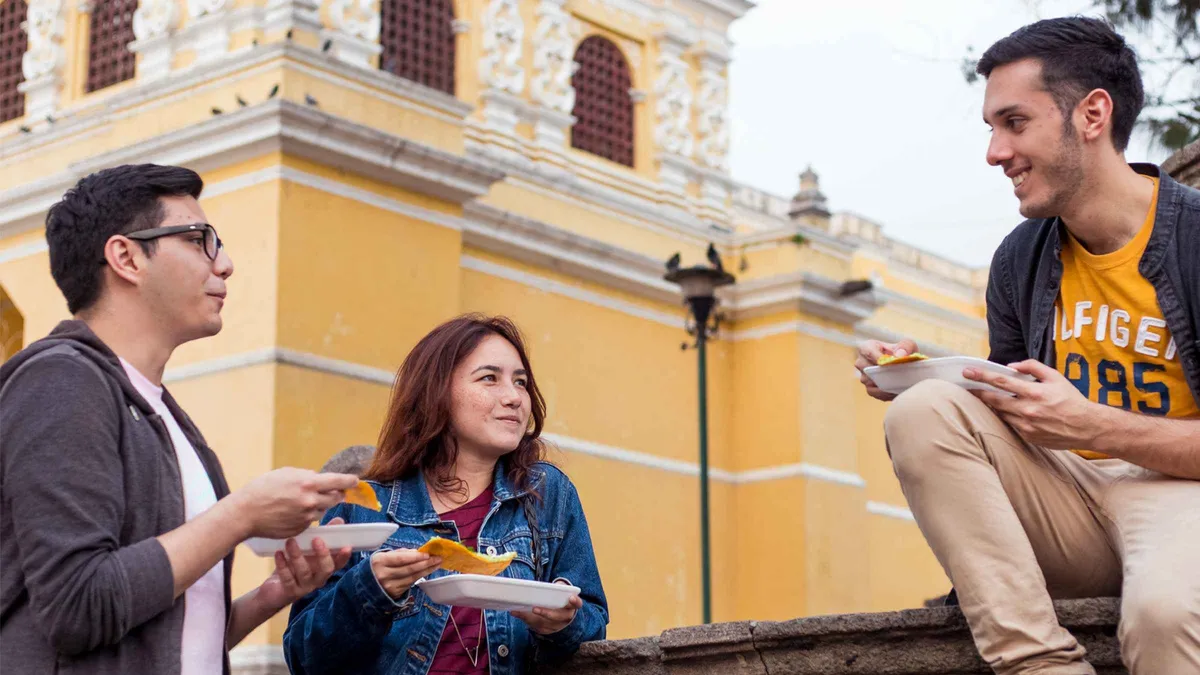
Guatemala City: One way Shared Transfer to Antigua
Shared van between Guatemala City and Antigua; the budget door-to-door with luggage space.
Check Availability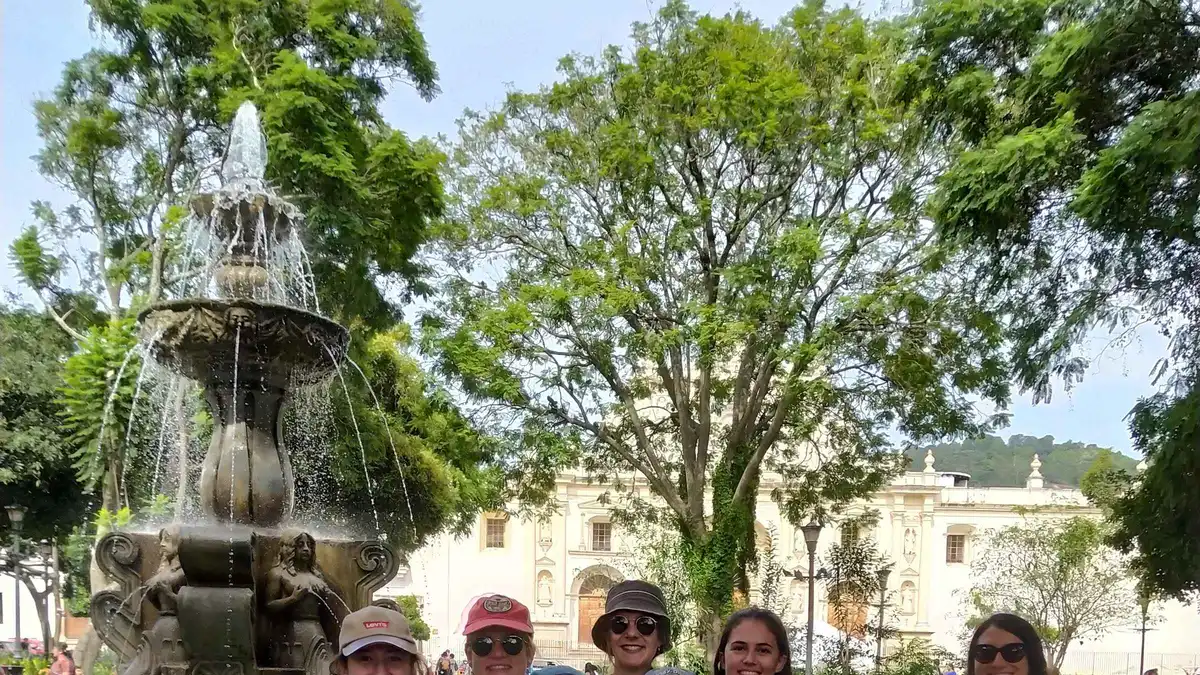 from $25
Antigua Guatemala: City Highlights Guided Walking Tour
2.5-hour small-group walk through the grid with a licensed guide; the fastest way to make the ruins and churches mean something.
Check Availability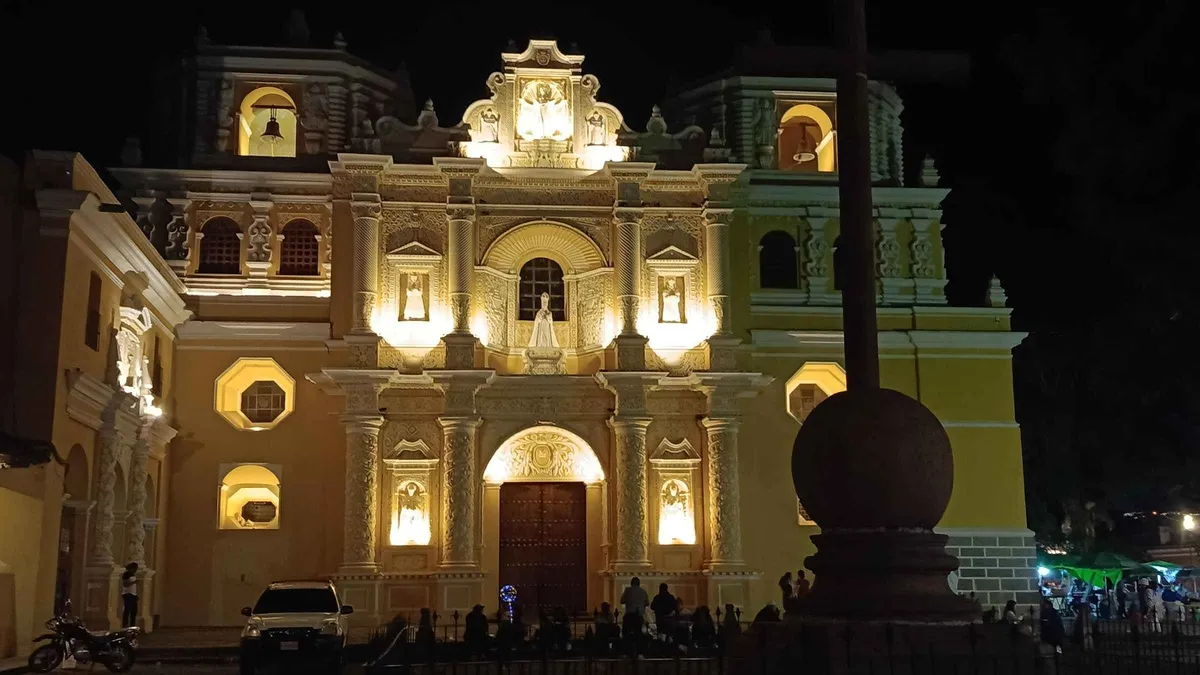 from $25
La Antigua Myths and Legends Stories Night Walking Tour
Two hours of the city's legends after dark; the nightlife option that does not involve a bar.
Check Availability from $92
Lake Atitlan One Day Tour from Antigua
Shared day tour to three Atitlan villages with boat crossings; the classic lake day from Antigua.
Check AvailabilityPrices, ratings and details are the platform's own. dollar figures are the listed prices — the platform bills in your account's currency.
Next
The planning hub
Every practical page in one grid, from trip planning to money and safety.
Where to stay
The areas, and which ones keep car access during the perimeter.
Flying in
The airport run that decides whether Holy Week starts calmly.
The weather page
What late March feels like at 1,530 m.
Semana Santa Questions, Answered
When is Semana Santa in Antigua Guatemala in 2027?
The anchor dates are Palm Sunday 21 March, Holy Thursday 25 March, Good Friday 26 March and Easter Sunday 28 March 2027. They are computed from the Easter date under the Gregorian computus, and this guide flags them for a calendar cross-check at launch, so confirm against a published calendar before booking non-refundable travel. The full day-by-day structure, from Ash Wednesday on 10 February through the six Lent Sundays, is laid out in the key days of the season.
How is Semana Santa celebrated in Antigua Guatemala?
Through velaciones and processions over alfombras. A velación is a vigil display built around the procession image, open to visitors. A procession is the anda carried on the shoulders of cucuruchos across carpets of dyed sawdust laid on the streets by families. The municipal 2026 plan counted about 56 velaciones and 58 processions, with a pedestrian perimeter from 4:00 a.m. on the big days and free buses from the park-and-ride lots. Compare where to stay to be inside the action.
What days have processions in Antigua Guatemala?
Every Lent Sunday, from 14 February to 14 March in 2027, carries one procession through the city, and Holy Week runs daily from Palm Sunday to Easter Sunday. The named processions of the city include Jesús Nazareno del Milagro, Jesús Nazareno del Perdón and el Señor Sepultado de la Escuela de Cristo. Exact routes and start times come from each hermandad and the municipality, and the 2027 programación is not yet published. In season, the municipal assistant carries real-time locations.
What are the alfombras made of?
Dyed sawdust, called aserrín, worked through stencils into designs and laid directly on the cobblestones. Families, neighbours, coworkers and brotherhoods build them on the street during Holy Week week, often finishing only hours before their procession passes. The anda walks over the carpet, the remains are swept away, and the next carpet goes down on the same stretch. The full craft, the etiquette and where the carpet streets concentrate are covered in the alfombras guide.
Is Antigua Guatemala crowded during Semana Santa?
It is the busiest week of the Antigua calendar, and Good Friday is the densest single day. A pedestrian perimeter closes the center to traffic from 4:00 a.m. on the big days, so the city runs entirely on foot. The municipality manages the pressure with park-and-ride lots, a Q40 ($5.24) daily car cap at the big lots, free shuttle buses and a live parking map. The practical response is to sleep in town or near a free-bus lot. See getting around for how the city moves.
How much does it cost to visit during Semana Santa?
Watching from the curb is free. The fixed municipal costs are small: the MarbEx sticker runs Q10–Q20 ($1.31–$2.62) for cars and the daily parking cap at Santa Inés and La Pólvora is Q40 ($5.24). The real variable is the arrival, where shared shuttles run around $24 per person on the platform while private transfers cost more, and operator rates like Turansa's are explicitly invalid during Holy Week. Break down the rest in what a day costs.
The Season on Film
Three films that show what the schedule cannot: the scale of the processions, the carpet work and the crowds.
Antigua, Guatemala Easter Processions
A ground-level view of how the processions, the anda and the alfombras fit together over a Holy Week day.
Video: Grateful GnomadsWATCH: Antigua Guatemala Holy Thursday Procession Stuns With Faith, Color, and Tradition | AK1B
Holy Thursday's atmosphere, from the velaciones to the evening procession, exactly as the table above frames it.
Video: DRM NewsHow Easter is celebrated in Guatemala | Semana Santa en Antigua
The whole tradition explained in one sitting, a good primer before you stand at a curb yourself.
Video: Tony Ipina FilmsVideos load from YouTube only when you press play.
We may earn a commission if you book through one of our links, at no extra cost to you. Full affiliate disclosure